
Products
Fan Wheels for Diverse Air Movement Applications
Fan wheels play a critical role in determining the performance, efficiency, and application of a fan system. Common wheel types include forward-curved, backward-inclined, radial blade, and airfoil designs—each offering unique advantages. Forward-curved wheels are ideal for low to medium pressure applications, providing high airflow at lower speeds with compact construction. Backward-inclined wheels deliver higher efficiency and are well-suited for medium to high pressure systems, often reducing energy consumption. Radial blade wheels are rugged and durable, making them a reliable choice for handling particulate-laden or high-temperature air streams. Airfoil wheels, designed with aerodynamic blade profiles, offer superior efficiency and quiet operation, making them excellent for large air volume applications. Together, these wheel types provide versatile solutions to meet a wide range of ventilation, process, and air handling requirements.
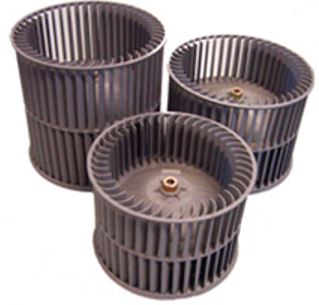
Forward Curved Wheels
Forward-curved wheels are designed to deliver high airflow at relatively low static pressures, making them a popular choice for HVAC systems, air handling units, and clean air applications. Their compact, closely spaced blades move air efficiently at lower rotational speeds, resulting in quiet operation and smooth airflow. These wheels are particularly well-suited for low to medium pressure systems, such as supply and return air in commercial buildings, residential ventilation, and packaged equipment. Forward-curved designs provide excellent performance in applications requiring high volume with moderate pressure, offering a cost-effective and energy-efficient solution for many standard ventilation needs.
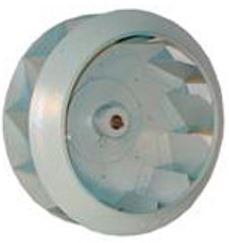
Backward Inclined Wheels
Backward-inclined wheels are engineered for high-efficiency performance in medium to high pressure applications. Their blades are angled opposite to the direction of rotation, allowing air to flow smoothly through the wheel with reduced turbulence and energy loss. This design delivers excellent efficiency, lower power consumption, and quieter operation compared to many other wheel types. Backward-inclined wheels are commonly used in HVAC systems, air handling units, process ventilation, and clean air industrial applications where energy efficiency and consistent performance are essential. Their non-overloading power characteristic also provides additional safety and reliability for demanding air movement systems.
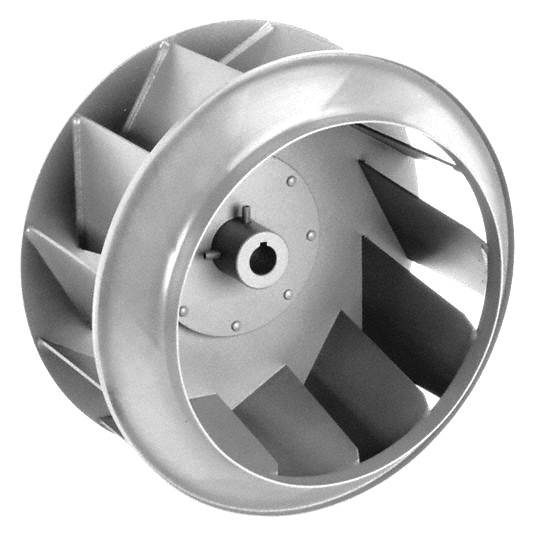
Backward Curved Wheel
Backward-curved wheels are engineered for high-performance airflow with excellent energy efficiency. Their blades are more steeply curved away from the direction of rotation than backward-inclined wheels, creating smooth and efficient air movement while minimizing turbulence. These wheels are ideal for clean air systems, offering quiet operation and reliable performance in higher static pressure applications. Backward-curved wheels are commonly used in HVAC air handling units, clean room ventilation, and process systems where efficient, stable airflow is required without sacrificing energy savings.
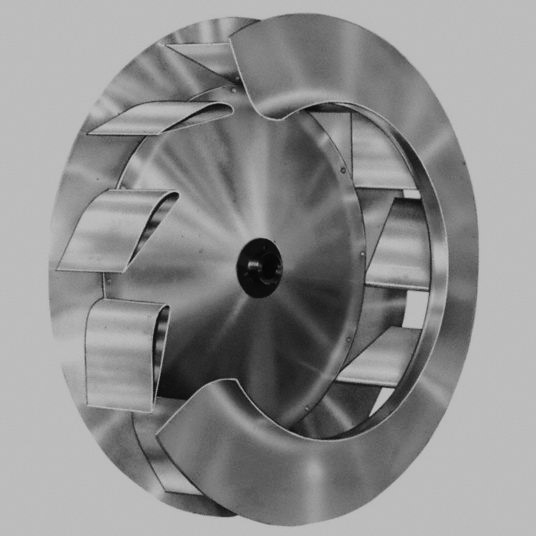
Airfoil Wheels
Airfoil wheels are designed with aerodynamically shaped blades that closely resemble an airplane wing, enabling exceptional efficiency and quiet operation. This blade profile reduces turbulence and energy loss, allowing for high airflow performance at lower power consumption. Airfoil wheels are well-suited for clean air applications where energy efficiency, smooth airflow, and noise reduction are priorities. Common uses include HVAC air handling units, large commercial ventilation systems, and industrial supply air applications. Their non-overloading power characteristics make them a reliable, long-term solution for high-volume, low-to-medium pressure systems.
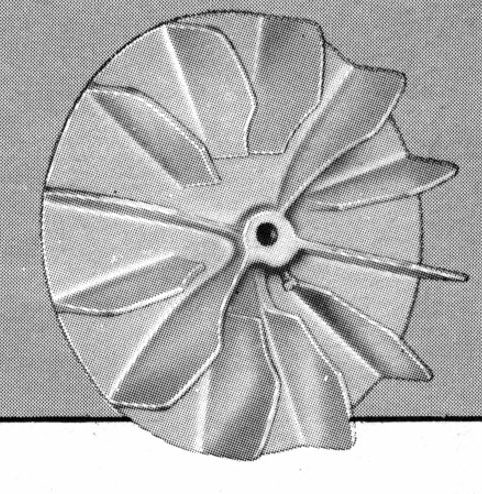
Radial Blades
Radial blade wheels are built for durability and dependable performance in demanding environments. Featuring straight, heavy-duty blades arranged radially from the hub, these wheels are well-suited for handling particulate-laden air, high temperatures, or corrosive airstreams. Their rugged design allows them to maintain stable performance under harsh conditions, making them ideal for industrial ventilation, dust collection, fume extraction, and material handling applications. Unlike forward or backward-inclined wheels, radial blade wheels generate higher static pressures at lower volumes, offering excellent resistance to buildup and easy maintenance. This makes them a reliable choice for heavy-duty air movement where strength and longevity are critical.
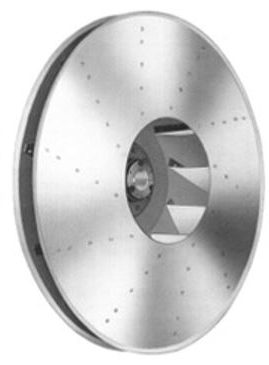
Flanged Radial Blade
Flanged radial blade wheels are a specialized variation of the standard radial design, engineered to deliver enhanced structural strength and improved air handling performance in heavy-duty applications. The addition of flanged blade edges increases the wheel’s rigidity, allowing it to withstand higher pressures and more demanding operating conditions. This design helps maintain stable performance while minimizing deformation or wear, even in systems handling abrasive or high-temperature air streams. Flanged radial blade wheels are commonly used in material handling, dust collection, fume extraction, and other industrial processes where durability, reliability, and consistent airflow are essential. Their robust construction makes them an excellent choice for challenging ventilation environments.
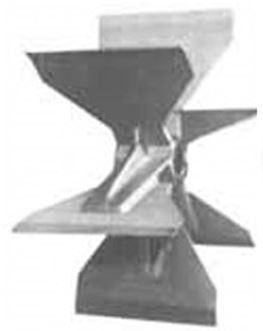
Paddle Wheel
Paddle wheel, or open radial, wheels feature flat, widely spaced blades arranged radially from the hub. This simple, rugged design makes them ideal for handling contaminated or particulate-laden air streams, as they resist buildup and are easy to maintain. While they operate at lower efficiencies than airfoil or backward-curved designs, their strength and resistance to wear make them a preferred choice in demanding industrial environments. Paddle wheel fans are often used in dust collection, fume extraction, material handling, and other heavy-duty applications where durability and reliability are more critical than energy efficiency.
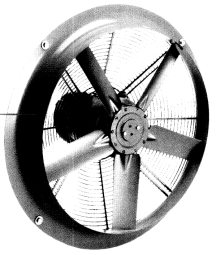
Axial Propeller Wheels
Axial propeller wheels are designed to move large volumes of air at low static pressures, making them a cost-effective and efficient solution for general ventilation and cooling. Their simple, lightweight propeller-style blade design allows air to flow parallel to the fan shaft, providing high capacity with minimal power consumption. Axial propeller fans are commonly used in rooftop exhaust, wall-mounted ventilation, agricultural buildings, cooling towers, and general industrial spaces. Their straightforward design ensures easy installation, low maintenance, and dependable performance in a wide range of airflow applications.